Showing posts with label science. Show all posts

Wednesday, August 26, 2009

Scopes Redux

So, apparently, the U.S. Chamber of Commerce wants to challenge global warming, in court:
The U.S. Chamber of Commerce, trying to ward off potentially sweeping federal emissions regulations, is pushing the Environmental Protection Agency to hold a rare public hearing on the scientific evidence for man-made climate change.

Chamber officials say it would be "the Scopes monkey trial of the 21st century" -- complete with witnesses, cross-examinations and a judge who would rule, essentially, on whether humans are warming the planet to dangerous effect.
My brain is exploding with reactions to this:
  • How is the courtroom the right place to decide the truth of scientific matters?
  • Well, maybe it is. It is the place where the facts are determined behind criminal matters. In these cases, it is not the law that is in dispute, but rather the facts that determine how the law should be applied.
  • Is this more of a PR stunt than a legal stunt? Is it a way to get Joe Public on the side of business?
Maybe the real issue comes down to this quote:
EPA is set to formally declare that the heat-trapping gases scientists blame for climate change endanger human health, and are thus subject to regulation under the Clean Air Act.
And more questions:
  • Is it right for the EPA to expand its regulatory powers to include carbon dioxide?
  • Do businesses affected by this expansion have the right to fight it in court?
  • Why attack the science instead of attacking the interpretation of the Clean Air Act?
  • And maybe most confounding, why would the U.S. Chamber of Commerce invoke the Scopes monkey trial when the scientific standpoint won out (and the opposition is seen as a laughingstock)?
I'm still processing all of this, but my initial reactions are:
  • I'd love to see a balanced debate on the issue of global warming, where scientific studies are brought to light.
  • On the other hand, there does seem to be something wrong with having a legal expert decide scientific theory.
  • Regulating greenhouse gases by the EPA should take an act of Congress, not an interpretation of the Clean Air Act.
[Story seen through Slashdot]

Monday, August 24, 2009

If Geeks Ruled the Universe

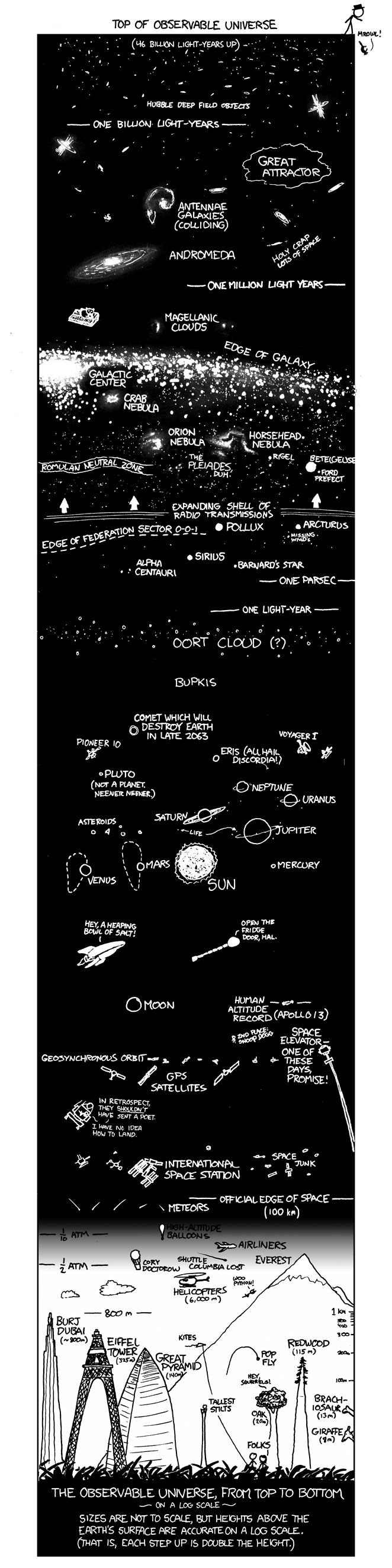
After seeing this comic, I just had to put in a plug for xkcd:

Crude? Sometimes. Off the charts geeky? Always. Blowing my mind with humor and/or that someone else thinks like this? Often.

Monday, July 6, 2009

Let There Be Light Speed

The other day, I was thinking about what I see to be the biggest problem with the Young Earth theory. (Yes, I think about those things in my free time... but I also think about baseball statistics and ways to solve puzzles, so I think I've secured my geek status well before this posting.)

I don't have the expertise in biology or geology to comment on those aspects intelligently. However, I do have a good grounding in astronomy, and there's one problem I can't get avoid, any time I can look up at the sky on a clear, dark night. The problem is that I can see the Milky Way, and in especially dark areas, the Andromeda Galaxy. Why is that a problem? Well, because they are really far away. The Andromeda Galaxy, for example, is 2.5 million light-years away.

The problem is not in the size of the universe, but in the fact that we can see it. When we look at the Andromeda Galaxy, we not only see something 2.5 million light-years away, but 2.5 million years ago. The light we can see in our night sky was produced from the stars in that galaxy 2,500,000 years ago. That just doesn't jive with the Young Earth theory of Creation happening less than 10,000 years ago.

Here are some other false starts of explanations:

Light was created (Day 1) before the Earth was created (Day 2?). The problem with this is though light was created on Day 1, the stars were created on Day 4, after the Earth was created. Even if that weren't the case, the literal interpretation only places 24 hours between creation of light and creation of earth, not 20,000 centuries.

Light was created "on its way", such that we could see all that God had created. While this would explain it, it seems on par with God creating an afterimage of the risen Lord as the sign of his resurrection. We'd see it, but it wouldn't be what's really real. For instance, we can see a supernova go off in a far away galaxy, from which the light couldn't possibly have reached us (i.e. we're still seeing light created on the way). That would mean the supernova didn't actually happen, and yet we see it. In other words, this explanation makes God a deceiver. Not a good plan.

Last try, and the one I was fiddling with. Maybe at the Fall (or the Flood), God set the speed of light. Beforehand, along with other laws of physics being different, light traveled at a near-infinite speed. Then, as part of our restriction as a fallen race, God made sure we were limited to our solar system, and only had interstellar travel in the movies. The problem with that is that the light itself would be distorted on the change in speed. There might be a tremendous gap of darkness, with all the pre-fall light having already reached us and the post-fall light not getting here yet. If the light gradually slows, it would be stretched out and therefore drastically red-shifted. If the light was instead repeated to fill the interval, then we couldn't see any galactic variations, such as supernovae.

There's just no way I can see reconciling a literal reading of the 6 days of creation to the observations any person in a rural area can make. This still allows for creation to occur, but only if freed from, in my opinion, the totally unnecessary restriction that it all happens in under a week.

Sunday, June 28, 2009

Life, The Universe, and Everything

In the past ten days or so, two articles on Space.com appeared, one on Mars and the other on Titan (Saturn's largest moon). Both talk of lakes on the surface of the globes: Mars a past water ocean, Titan a current methane lake system. And then both then mention the possibility of life developing there. Why is that? Why not stick to the questions at hand rather than going to conjecture? I can think of several reasons.
  • Journalistic appeal: an article on a far away lake is not interesting. The discovery of life outside of the Earth is.
  • Scientific longing: the desire to find something mind-blowing and paradigm-shifting.
  • Biological practicality: just like in the jungles of the Amazon, finding diverse life teaches us more about the life we know, and can grant us cures we couldn't get otherwise.
  • Historical genesis: if basic life is forming on other worlds, that would fill us in on how things may have come about here on earth.
  • Philosophical ache: one of the basic questions of this generation is, Are we alone in the universe?
  • Mythological debunking: if we find life on other planets, especially in the early stages, it puts a dent in the claims of a Creator God making a special Earth filled with fully-developed beasts.
This last one intrigues me especially, considering what the Bible says about life on other planets. What does it say? Oh yeah, nothing. Genesis talks about God's creation process on Earth, and it is only a weak inference that leads us to believe that life cannot be elsewhere. Furthermore, even if we hold to a special creation happening here on Earth (which I don't believe is strictly necessary according to Scripture), that does not preclude life developing naturally, does it? If Jesus heals a blind man, does that mean we cannot do the same using natural means?

In the same way finding other planets expanded our horizons of the grandeur of God's creation, so too the finding of life will open our eyes to the vastness of God's plan. Who knows? Other sentient life may exist in this vast universe, and it may be the call of our descendants to be witnesses to the end of their worlds, too (Acts 1:8).

Monday, May 11, 2009

Live Long and Prosper

I've been a fan of Star Trek for quite some time, and am excited to see the latest movie. One of the intriguing aspects proposed by the series is whether Earth as a whole could join together and be at peace within itself. It's a great ideal, and some psychologists believe we can get there.

So, can we as a human species free ourselves from the horrors of war? Unfortunately, my vote is no, at least apart from Christ's reign.

First, Scripture indicates somewhat clearly that wars will continue to come. In the context of the "end times", Jesus says:
When you hear of wars and revolutions, do not be frightened. These things must happen first, but the end will not come right away." Then he said to them: "Nation will rise against nation, and kingdom against kingdom.
Also, the second Rider in Revelation is "given power to take peace from the earth and to make men slay each other."

But let's say for the sake of argument that a temporary but long-lasting peace could occur beforehand. At what scale would this peace occur? That is, in what sized groups would the fighting stop?

I can imagine that the combination of a global, interconnected economy and the growth of tolerance in the belief sets would make it possible, one day, for no nation to want to cause harm to any other nation. This might meet the technical definition of world peace, but not the spirit of it. After all, though the nations may try to stop it, groups of varying sizes (from dozens to thousands) will still exist for the purpose of causing harm. That means terrorist cells, organized crime syndicates, and gangs will not disappear. So, sure, India and Pakistan may call a truce, and somehow Israel and the rest of the Middle East could come to terms, but I can't see terrorist attacks or turf wars becoming historical oddities.

Why the pessimism? Because it's in our nature. We're all inherently selfish. Our natural reaction when we feel disenfranchised is to fight back if we can. And the most effective way of fighting back is to find others also willing to fight back. And why will there be those who feel disenfranchised? Because we as human beings do a pretty miserable job of following the simplest of rules Jesus laid down for us: "Love your neighbor as yourself."

If every human being aimed to follow this Golden Rule, we may not eliminate all conflict, but we'd sure be a whole lot closer to Star Trek than we are right now.

Friday, April 10, 2009

Two Words that Blow My Mind

I saw the Holy City, the new Jerusalem, coming down out of heaven from God... The city was laid out like a square, as long as it was wide. He measured the city with the rod and found it to be 12,000 stadia in length, and as wide and high as it is long.
-- Revelation 21:2, 16
Such a wonderful vision of hope--God replacing our decaying world with a new one--followed by a description of the city, complete with measurements. (As a side note, anyone know why God gives us the measurements of things seen in visions? I don't think we're going to re-construct this, and I'm pretty sure we'll know it when we see it. "Wait, no, this one's only 10,000 stadia... can't be the Holy City.")

In this passage, however, I am more struck with awe than hope. And simply because of two words. But before getting to those words, I want to discuss the rest of the passage. First, it helps to understand that 12,000 stadia is equivalent to 1,400 miles. So, when God is describing a city laid out like a square 1,400 miles on a side, he's talking about something this size:
That's Fargo, ND in the upper-left, Miami, FL at the bottom, and Maine & Quebec in the upper-right. And God is describing this all as one big city.

But that's not the kicker for me. It's the two small words: "and high". Yes, those two words say that God's city is 1,400 miles TALL as well. It's one HUGE cube. To give some perspective, Mt. Everest is 5.5 miles high (from sea level). The space station orbits at an altitude of 217 miles. 1,400 miles is insanely high. And assuming John did not document the first declaration of airspace, these are some LARGE buildings.

Looking at it a different way. Say we peeled the entire earth like a giant orange, with the peel consisting of everything between the height of Everest (5.5 mi) and the lowest point on Earth, the Marianas Trench (6.8 mi below sea level). We then take this "peel" and stack it up inside this cube. We'd run out of "peel" with another 170 miles of space to go.

Or a geekier way to look at it: The Death Star was a sphere only 100 miles in diameter.

I'll tell you one thing: that's no moon!

Sunday, March 29, 2009

Week in Review - Down with 'The Man'

Coincidentally, all three stories I found intriguing this week feature different ways of bucking the system. Not so coincidentally, they all come courtesy of Slashdot.

Evolution vs. Texas: So, the Texas school board is voting on whether to force teachers to raise doubts on the theory of evolution. My first reaction is to get the politicians out of the determination of knowledge, but then I realize it is effectively their job to ensure the "right" things are being taught. Is it right to raise doubts on evolution? My heart says yes, and my mind says no. (I just wish I could find one creationist argument that isn't easily refuted by current science.) Instead, I'd offer that they raise doubts on science as a whole. First, since science deals with studying the natural realm, there are things that science by definition cannot account for (like the supernatural); it is simply out of scope. Second, that what we "know" through science is just the best explanation we've come up with for the data that we have. Tomorrow, new data or a new explanation may supplant everything.

Bringing me to...

Supernova vs. Scientists: Knock knock. Who's there? Early supernova. Early super... Bang! When a person shows up early, they're called punctual. When a plane shows up early, it's called a miracle. When a supernova shows up early, it makes scientists wonder if they need to throw their current stellar evolution theories out the window. Isn't learning wonderful? It just goes to show that scientists can be wrong.

Which leads me to...

Famous Scientist vs. All: Freeman Dyson, a renowned physicist (and known to Star Trek fans for the Dyson sphere), is up in arms over the global warming stir. He claims "that climate change has become an “obsession” — the primary article of faith for “a worldwide secular religion” known as environmentalism." The saddest part of the whole situation is not in the disagreement, or that he's in the vast minority, but that it has led to name-calling instead of the intellectual discussion it deserves.

Several times I've seen a bumper sticker of the Anthony J. D'Angelo quote:
Your mind is like a parachute. It only works if it is open.
I completely agree with this statement. But a mind and a parachute also only work if they are properly anchored. So, keep your mind open, but also keep it tethered to the truth supported by evidence, whether it is the data of science or the historical accuracy of Scripture. Without it, your parachute may be open, but you'll be in for a very unpleasant surprise.

Monday, March 23, 2009

Week(s) in Review : Science & Faith

After a few weeks of spending free time and energy taking care of a sick daughter, it's time to review the news that sounded interesting to me:

If We Have Free Will, Then So Do Electrons - Yes, I'll admit to having not read the article, and instead getting the gist of it from the Slashdot comments. Oh well. It looks to be an 'Oh well' on the article as well, basically defining free will as non-deterministic. The problem is 'random' is non-deterministic, too.

Degree in Creation Science? - So, the question is can any (non-profit, private) institute confer a degree upon someone? I guess the simple answer is 'sure', but it won't be worth the imitation sheepskin it's printed on. The real question, though, is whether Creation Science should be acknowledged as a legitimate scientific branch. I don't know enough about the work being done in that field, but my gut says the main goal it is achieving is making all Christians look like they're still living in the Dark Ages.

Fewer Americans are Christian - Well, it also says more Americans are evangelical. To me, it says more Americans are getting honest about what they believe and have stopped labeling themselves Christians just because their parents were or they got married in a church. It's clear from the Bible that Jesus wants us to stop pretending and be open and honest... that's how He'll reach us and make us Christ-followers, and Christ-like.

Wednesday, January 14, 2009

To the Moon with Extremist Toleration

Lately I've been exposed to a number of articles just like this one that ooze religious tolerance. Now I'm all for each person being able to seek (or not seek) after God and follow his or her own path of spirituality, but I feel articles like this go too far. They seem to treat different religions as if they were flavors of ice cream; each person has a favorite, but clearly there is no right one that everyone should consume. And just because vanilla is the most popular doesn't mean that it's better than rocky road.

The problem with this hypothesis is that most religions--and most people who hold beliefs--don't treat the belief as if it is something internal to themselves. When they pray to God, most don't do it because they believe it's a form of "positive thinking"; they pray because they believe there is an actual God outside of them that may hear them.

The lesser form of the argument for extremist toleration is that we can't know which religion is right, so all have equal footing. And if religions were just made up of human thoughts trying to make sense of ethics, origins, and the afterlife, I'd wholeheartedly agree. However, many of them claim that real events occurred in real places at real points in time. Either Moses received the Ten Commandments from God or he didn't; either Jesus died on a cross and was resurrected or he didn't; either Muhammad received revelation from Allah or he didn't; either Joseph Smith received the Book of Mormon or he didn't.

Each of these events, and countless others, claim to have occurred in actual space-time, and therefore there is evidence that supports the case or does not. So, given this, it follows that there is one truth among all the stories; one sequence of events that actually happened on planet Earth. My personal research indicates that the events of Christianity are the most likely to have occurred--more likely than they did not. And books have been written to provide evidence for this case. Is it an absolute proof? Of course not. Is it enough to prove beyond a reasonable doubt? Maybe. Is it enough that it bears taking note of? Certainly.

As to the actions of Tim Tebow, I respectfully disagree with the author and state it is good for everything. I think it would be good no matter his religion, as it keeps the dialogue open to discuss the evidence behind each one. But I think it is even better because the one he promotes most likely corresponds to the truth. If we as a society stop weighing beliefs against the evidences and only shout "Tolerance!" for all viewpoints, we find ourselves going down the path that must say the Apollo moon landings could be fake, and is a belief just as valid as their happening. After all, it would be exclusionary of us to call the belief of the majority "right".

Tuesday, September 2, 2008

Monogamy Gene

New Scientist is reporting that a "monogamy gene" has been found. From the article:
... men with two copies of RS3 334 were more likely to be unmarried than men with one or none, and if they were married, they were twice as likely to have a marital crisis.
What effect does this have on our reading of Scripture and its call to either completely monogamy or utter abstinence? How do we reconcile these findings with statements like the following:
"Haven't you read," [Jesus] replied, "that at the beginning the Creator 'made them male and female,' and said, 'For this reason a man will leave his father and mother and be united to his wife, and the two will become one flesh'? So they are no longer two, but one. Therefore what God has joined together, let man not separate." -- Matthew 19:4-6
Well, assuming it is confirmed by further studies, what does it mean? Does this entitle a part of the male population to skip out on that restriction, because that's how God genetically "made" them?

Umm... no. It's pretty clear from Scripture that all of us were born with a tendency to disobey God (see Romans 5), and despite that we are commanded to obey. Granted we cannot completely obey without daily submitting to Christ. But that's what we must do, whether our tendency to sin has been identified with a genetic marker or not. We must die to self, including the genes that make us "us".

Lord, help me to deny myself--even die to myself--and live for you alone!